Italiano per te
GCSE preparation course for learners with a background in Spanish
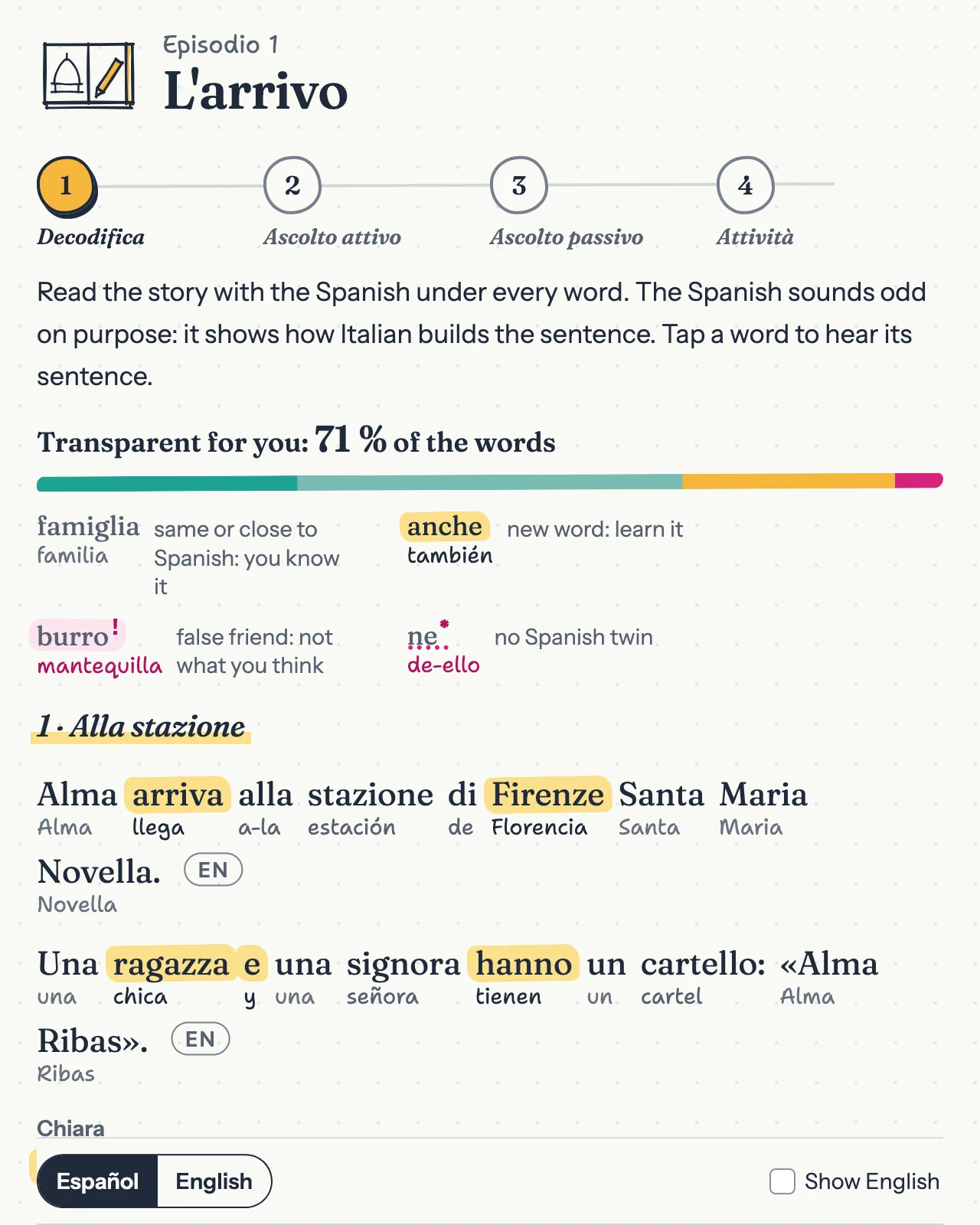
Italian: Alma arriva alla stazione di Firenze Santa Maria Novella. Spanish, word for word: Alma llega a-la estación de Florencia Santa Maria Novella
In English: Alma arrives at Santa Maria Novella station in Florence.
You just read your first Italian sentence.
This is how the story begins, and how the course teaches: the Spanish you speak sits under every Italian word until you no longer need it.
Register free 18 or overSign up as a parent child 13 to 17See inside the course
Free registration and use until the end of 28 February 2027. Adults, aged 18 or over, register themselves. Learners aged 13 to 17 are signed up by a parent: the parent signs up first and then adds the child's own email address.
Lo sai già
A lot of Italian is already yours
Italian and Spanish are close cousins. The course shows you which words and which grammar are already yours, so you spend your time on what is new.
Alma is 16 and comes from Montevideo. On her first evening in Florence, Chiara asks where she is from.
Chiara
Italian: E di dove sei? Sei spagnola? Spanish, word for word: y de dónde eres eres española
In English: And where are you from? Are you Spanish?
Alma
Italian: No, non sono spagnola. Sono uruguaiana, di Montevideo. Spanish, word for word: no no soy española soy uruguaya de Montevideo
In English: No, I'm not Spanish. I'm Uruguayan, from Montevideo.
- the same as Spanish, or close: you know it
- a new word: you learn it
- a false friend: not what you think
- no Spanish twin
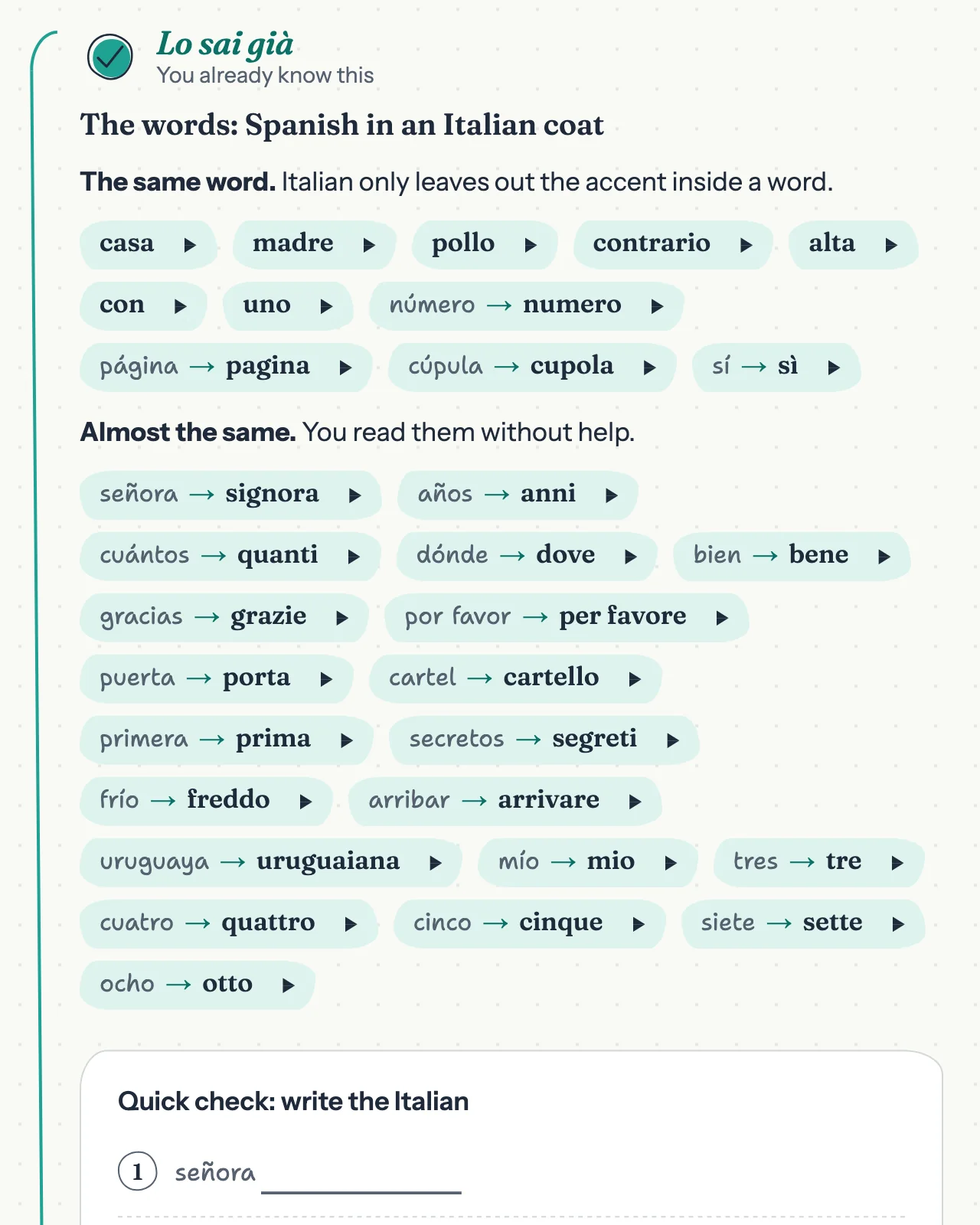
Words from the first episode that you can already read
- casa is casa
- madre is madre
- número is numero
- página is pagina
- cúpula is cupola
- señora is signora
- años is anni
- gracias is grazie
- por favor is per favore
- puerta is porta
- primera is prima
- secretos is segreti
- frío is freddo
- cuatro is quattro
- siete is sette
- ocho is otto
Three rules that turn Spanish into Italian
A sound that shifts in one word shifts in many. You learn the rule once and guess the Italian word yourself.
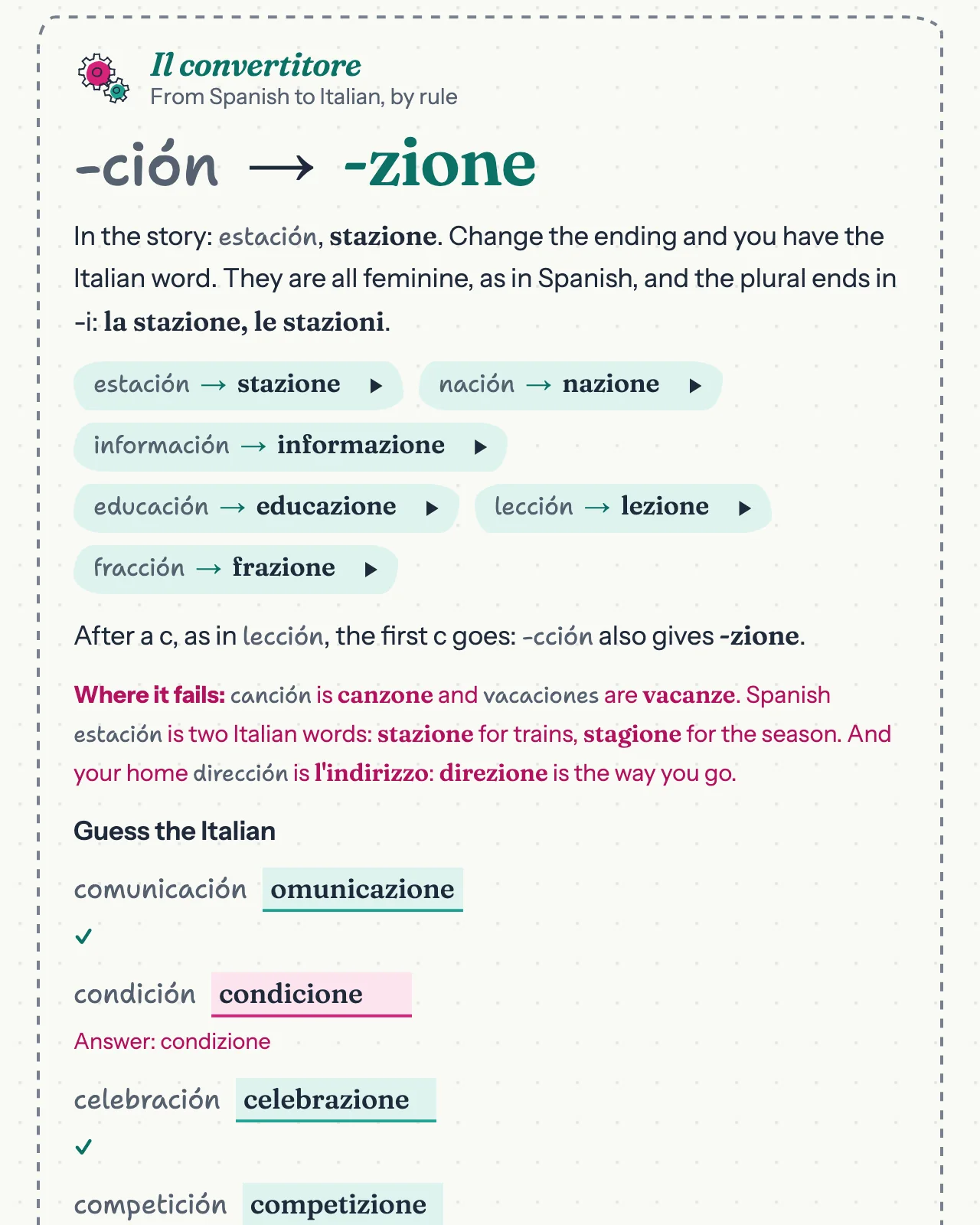
-ción becomes -zione
- estación is stazione
- nación is nazione
- lección is lezione
-dad becomes -tà
- edad is età
- ciudad is città
- universidad is università
es + consonant becomes s + consonant
- escuela is scuola
- España is Spagna
- estudiar is studiare
Every rule also says where it fails: canción is canzone, not canzione.
Diverso
And it slows down where Italian goes its own way
Some Italian words look Spanish and mean something else. In the story Alma walks into them first, so you remember them. It is warm at home, says Giulia.
Giulia
Italian: Andiamo: a casa fa caldo. Spanish, word for word: vamos a casa hace calor
In English: Let's go: it's warm at home.
Alma
Italian: Caldo? Di pollo? Spanish, word for word: calor de pollo
In English: Caldo? Like chicken broth?
Chiara
Italian: Ma no, non è una zuppa: è il contrario di «freddo»! Spanish, word for word: pero no no es una sopa es el contrario de frío
In English: No, silly, it's not a soup: it's the opposite of "cold"!
False friends from Week 1
Guess first. Then open the card.
caldo
A Spanish speaker thinkscaldo: broth, soup
What it means
hot, heat (caliente, calor)
guardare
A Spanish speaker thinksguardar: to keep, to put away
What it means
to look, to watch (mirar)
burro
A Spanish speaker thinksburro: a donkey
What it means
butter (mantequilla)
camera
A Spanish speaker thinkscámara: a camera
What it means
a room, a bedroom (habitación, cuarto)
Dentro il corso
Inside the course
Six pages of Week 1, exactly as a learner sees them today. Alma has just opened her bag.
Alma
Italian: Ecco il mio taccuino. È del mio bisnonno. Si chiama Ettore. Spanish, word for word: he-aquí el mío cuaderno es del mío bisabuelo se llama Ettore
In English: Here's my sketchbook. It belonged to my great-grandfather. His name is Ettore.
- Open the picture at full size
The story, decoded
Every lesson opens with an episode of Il taccuino di Firenze. Under each Italian word stands a Spanish word, and a colour tells you how close the two are.
- Open the picture at full size
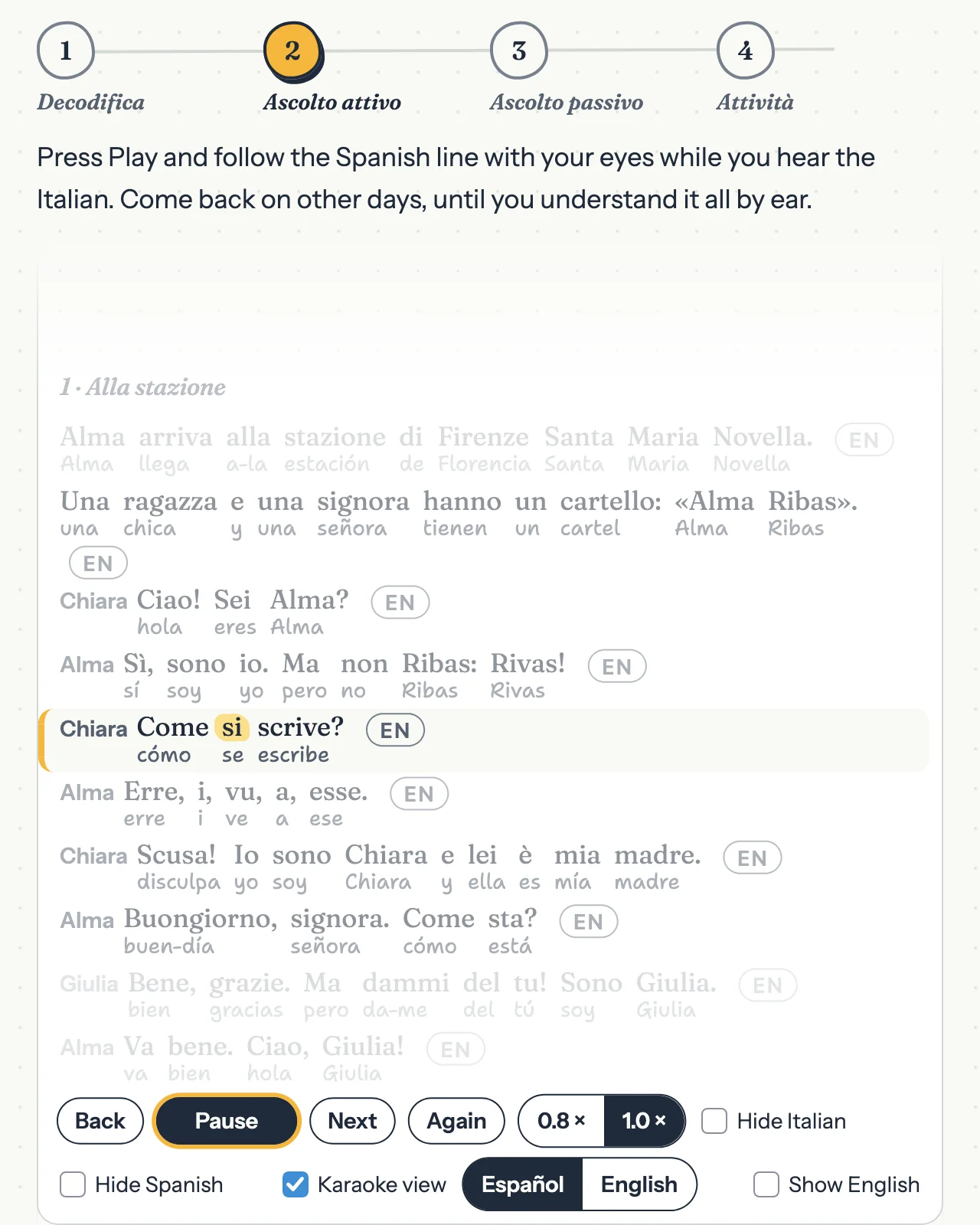
Listen and follow
Each line is recorded in Italian by a computer voice, with one voice for each character. The word you hear lights up, so your eyes and your ears learn together.
- Open the picture at full size
What you already know
A teal block collects what you already have from Spanish: the same words, the near twins and the grammar that works the same way. Look, check, move on.
- Open the picture at full size
A rule, and your own guess
A sound shift comes as a rule with examples, and with the places where it fails. Then you guess the Italian word, and every guess is marked at once.
- Open the picture at full size
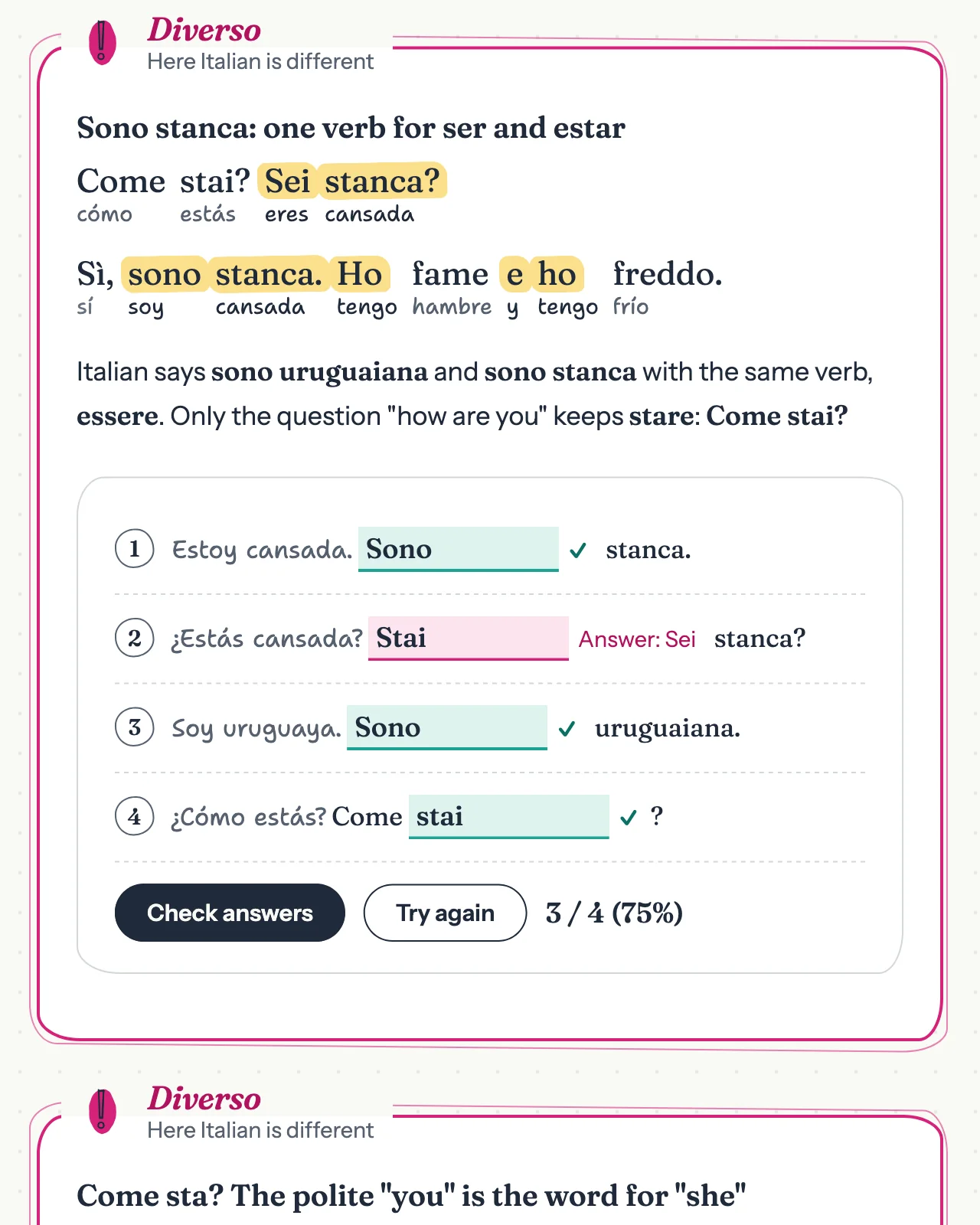
What is different
A magenta frame marks where Italian goes its own way. Here it is one verb, essere, where Spanish has ser and estar. This is where the practice is.
- Open the picture at full size
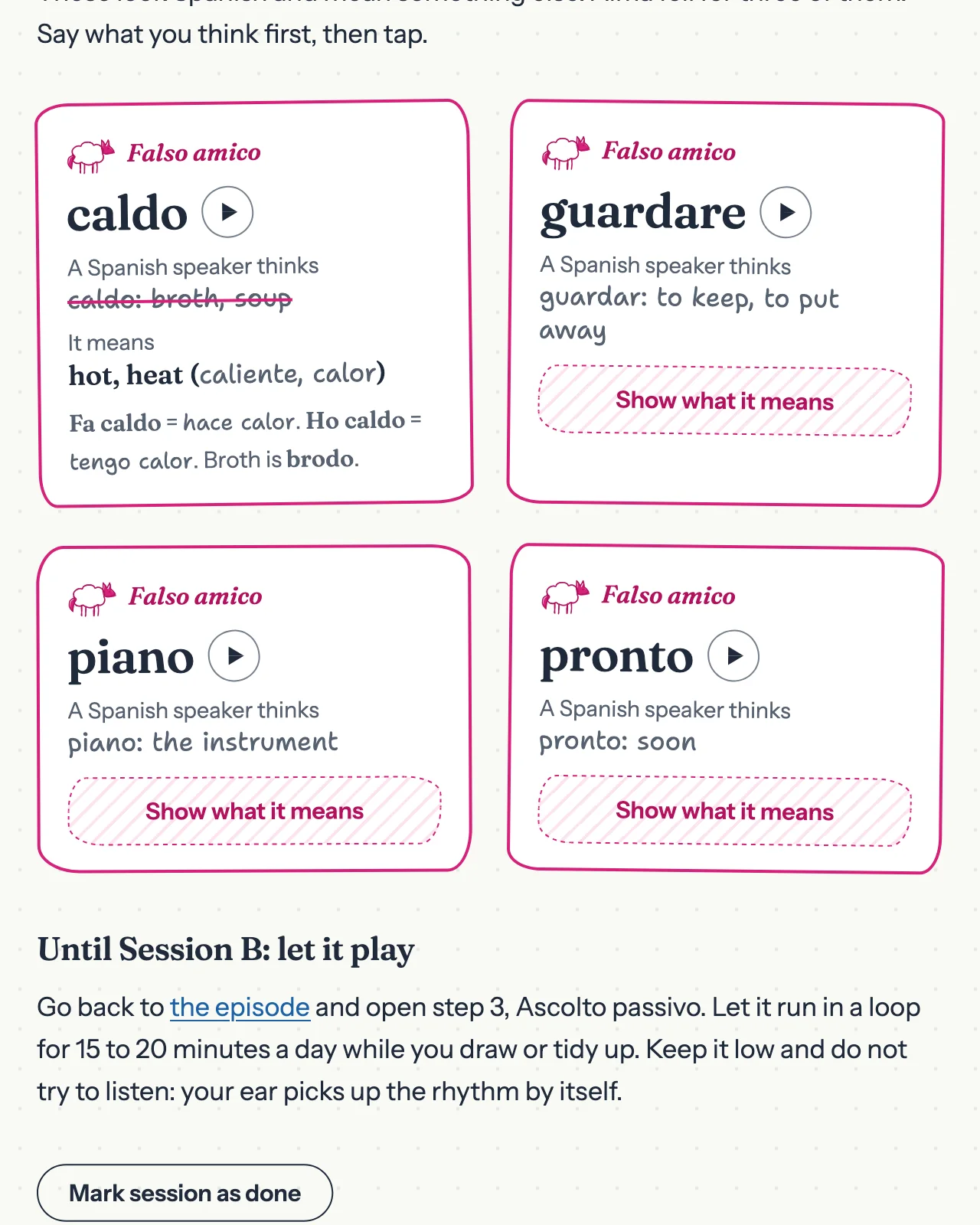
False friends, one card each
Each word that misleads a Spanish speaker gets a card: what you think it means, and then what it means.
Quattro passi
One episode, four steps
You work through every episode in the same four steps, and their order matters. Words and grammar get their names after you have met them in the story.
DecodificaDecode
You read the episode with a Spanish word under every Italian word. The Spanish sounds odd on purpose: it shows you how Italian builds a sentence.
Ascolto attivoActive listening
You play the recording and follow the Spanish line with your eyes, until you understand every word by ear.
Ascolto passivoPassive listening
During the week the episode plays in the background while you do something else. Your ear learns the melody.
AttivitàActivities
Only now you speak along, fill gaps and write. The exam practice lives here too.
The four steps follow the Birkenbihl method of learning a language.
Il tuo piano
A plan made for your exam date
You give the course two dates: the day you start and the day of your first exam. It builds your week plan from them, and it always keeps time for exam preparation.
Your start date
You choose the day.
Open now
- Week 1: Ciao! Sounds, spelling and me
- Week 2: Family, friends and describing people
- Week 3: Home and daily routine
- Week 4: Food, drink and the café
The next weeks
They open in blocks.
Exam preparation
The plan always keeps time for it.
Your first exam
You enter the date.
L'esame
The exam it prepares for
The course prepares for Pearson Edexcel GCSE Italian (1IN0) at Higher tier.
You sit the exam at an exam centre. The exam is not part of the course.
| Pearson Edexcel GCSE Italian (1IN0) | |
|---|---|
| Tier the course aims at | Higher |
| Papers | Listening, speaking, reading and writing |
| Translation | In both directions: into English and into Italian. The course practises both. |
| Speaking test in 2027 | Between 15 April and 20 May, on a day your exam centre sets |
| Listening and reading | 24 May 2027 |
| Writing | 11 June 2027 |
The dates are for summer 2027 and come from the exam board's own timetable. Your exam centre confirms your days.
Swirlwise is not affiliated with or endorsed by Pearson Education Limited. The name Pearson Edexcel stands here only to say which exam the course prepares for.
Chi è B.?
One page of the sketchbook, one question
The sketchbook belonged to Alma's great-grandfather, who left Florence in 1953. On its first page there is a dome, and one line.
Chiara
Italian: «Firenze, millenovecentocinquantatré. Per B., che sa guardare.» Chi è B.? Spanish, word for word: Florencia mil-novecientos-cincuenta-y-tres para B que sabe mirar quién es B
In English: "Florence, 1953. For B., who knows how to look." Who is B.?
The story
Italian: Alma guarda dalla finestra. La cupola del taccuino è lì. Spanish, word for word: Alma mira de-la ventana la cúpula del cuaderno es allí
In English: Alma looks out of the window. The dome from the sketchbook is right there.
Nobody in Alma's family knows who B. was. Each episode turns one more page.
That makes nine lines of Italian since the top of this page, and you read every one of them.
Free until the end of 28 February 2027
You register, and the course opens for you at once. Registration and use are free until the end of 28 February 2027. The offer ends on that day, and no price is set today.
You need an email address. Adults, aged 18 or over, register themselves. Learners aged 13 to 17 are signed up by a parent: the parent signs up first and then adds the child's own email address.
Domande
Questions learners and parents ask
- Is it free?
- Yes, until the end of 28 February 2027. You register with an email address, and registration and use cost nothing until that day. No price is set for the time after it.
- Who can register?
- Adults, aged 18 or over, register themselves. Learners aged 13 to 17 are signed up by a parent: the parent signs up first and then adds the child's own email address.
- Who is the course for?
- For learners with a background in Spanish who prepare for GCSE Italian. It is built for Pearson Edexcel GCSE Italian (1IN0) at Higher tier. The explanations are in simple English, and Spanish is the bridge.
- Do I need any Italian to start?
- No. The first lesson starts with sounds, spelling and how to say who you are. From the first sentence, a Spanish word stands under every Italian word.
- How long does it take?
- That depends on your dates. You give the course your start date and the date of your first exam, and it builds your week plan from them. It always keeps time for exam preparation.
- Are the voices real speakers?
- No. Every Italian line is recorded, with one fixed voice for each character, but the voices are computer voices with Italian pronunciation. They are good for practice. The exam uses real speakers, so it helps to listen to real Italian as well.
- Is the exam part of the course?
- No. You sit the exam at an exam centre, and your centre gives you your dates. The course prepares you for it.
Alma's first evening ends at a window. Yours can start now.
Register free 18 or overSign up as a parent child 13 to 17
Adults, aged 18 or over, register themselves. Learners aged 13 to 17 are signed up by a parent: the parent signs up first and then adds the child's own email address.
Who makes the course
Alexander TangMaster of Education
Course developer
Questions before you start? Write to us.