For Cambridge IGCSE Additional Mathematics (0606) and Cambridge O Level Additional Mathematics (4037)
Additional Maths from square one, for teenagers who learn at home.
Short lessons that check each step and give a hint before the answer. Built for independent learners aged about 14 and up. We plan to open in January 2027. Join the list and we'll tell you first.
- For learners aged about 14 and up
- At your own pace
- Chapters 1 to 4 in testing
- Waiting list open
Every topic in Additional Maths has a pattern. Find it one step at a time, then sit the real exam.
Inside the course
This is chapter 1, Functions, as a learner sees it. Every picture is a screen of the course as it is today. Chapters 1 to 4 are in testing now, and the others are being built.
- Open the picture at full size
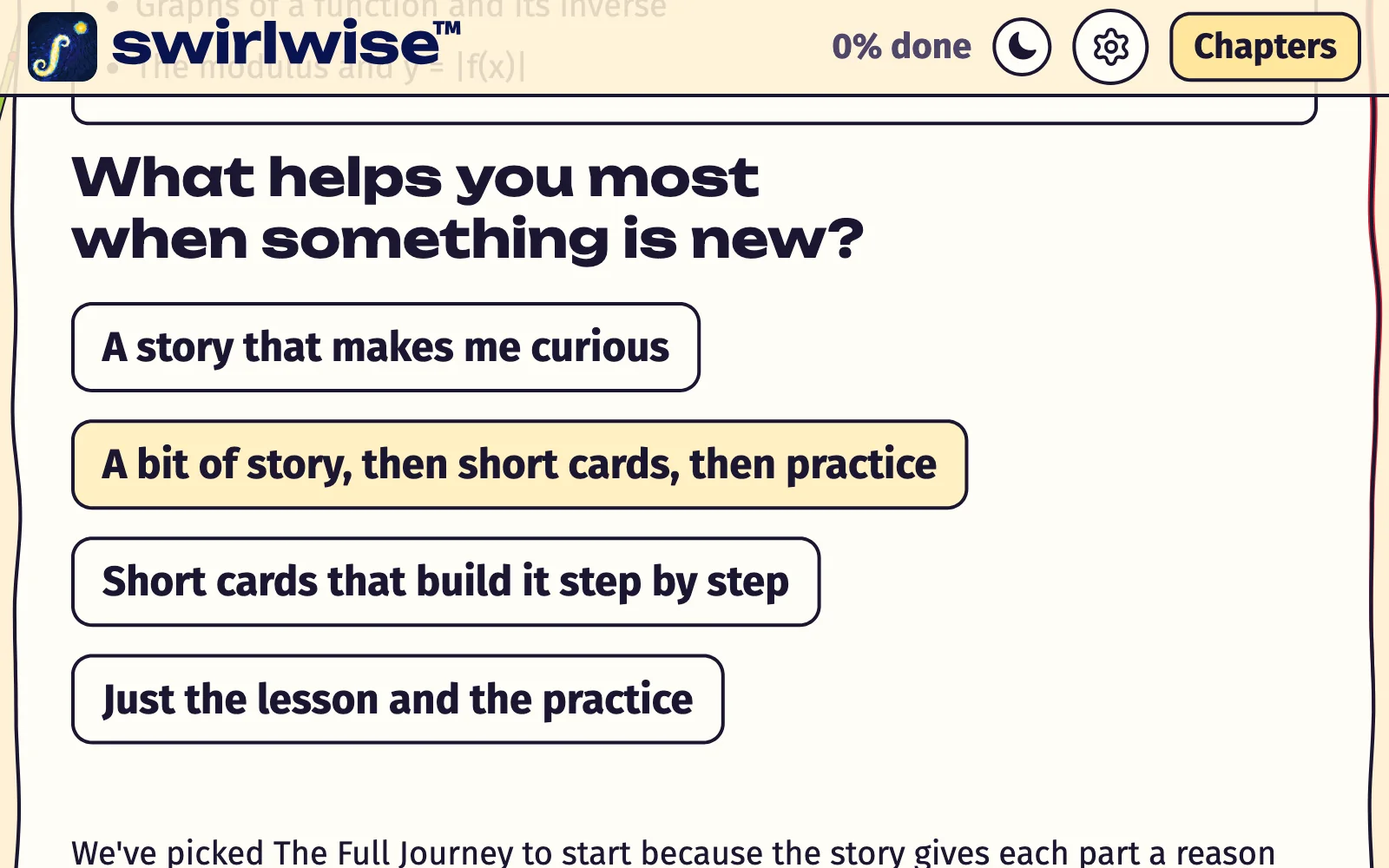
Your teenager picks the way in
A chapter can start with a story, with short cards, with both, or with the lesson straight away. The choice can change at any time, and no progress is lost.
- Open the picture at full size
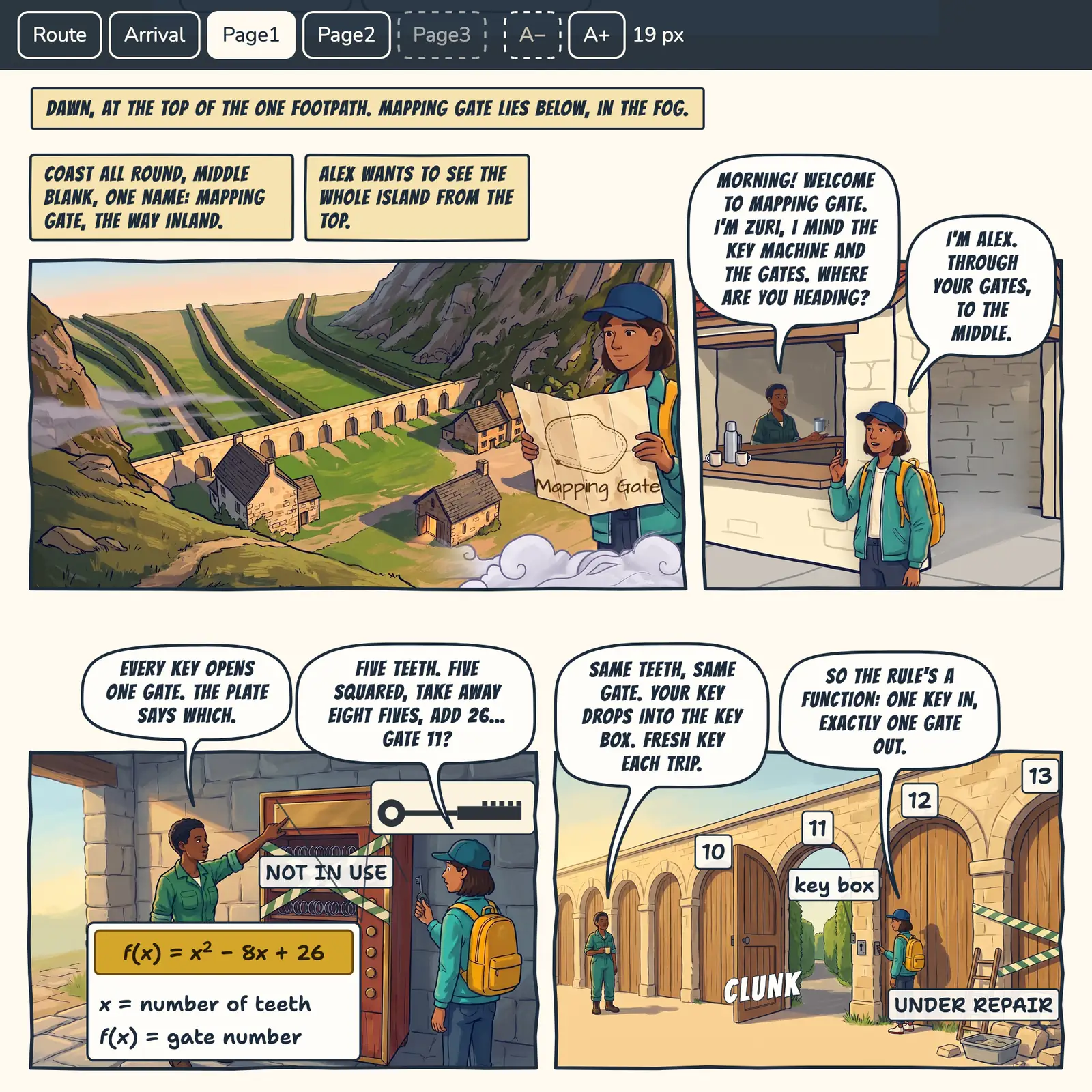
A story asks why before any rule
Chapter 1 opens with a comic set on an island that still has to be mapped. The hero carries the name your teenager picks. Every story page has a button to skip it.
- Open the picture at full size
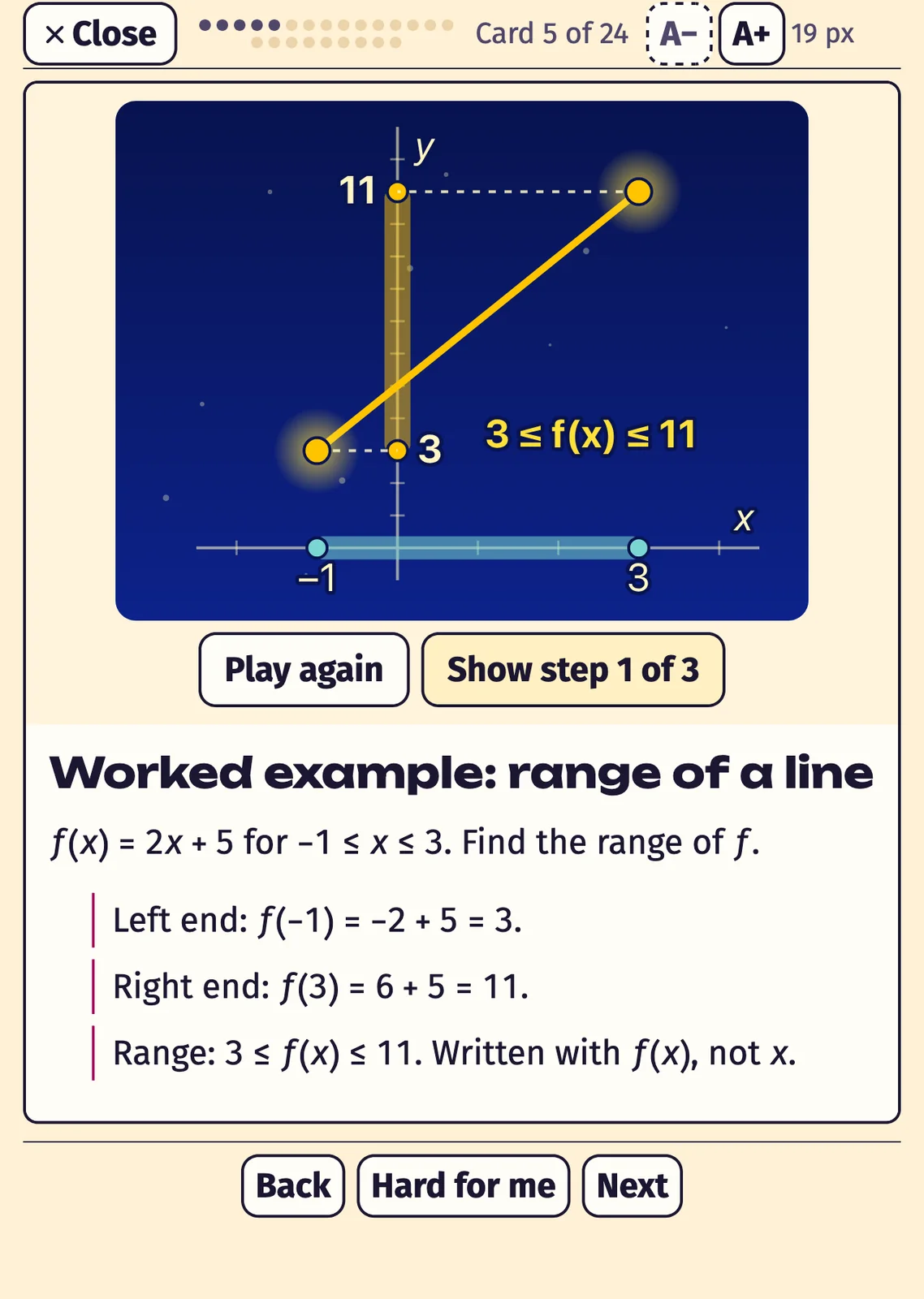
Worked examples, one step at a time
Short cards build each idea. A worked example shows its steps one by one, with the graph next to the working. In the next example, a step is left for your teenager.
- Open the picture at full size
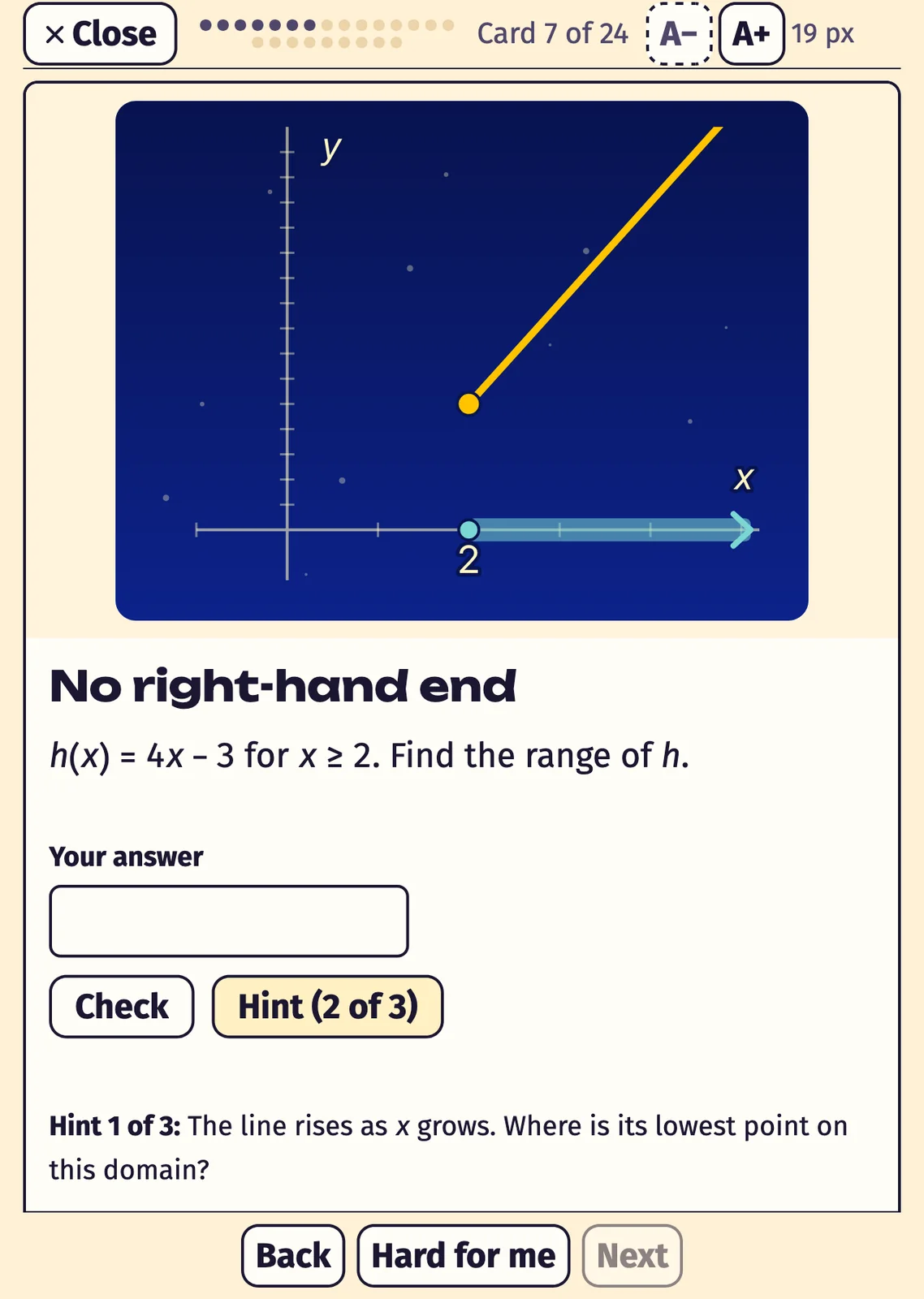
A hint before the answer
Each answer is checked at once. A question comes with up to three hints, opened one at a time, and a common slip gets a line that names it. A button says "This was hard for me", with no penalty.
- Open the picture at full size
How the marks are earned
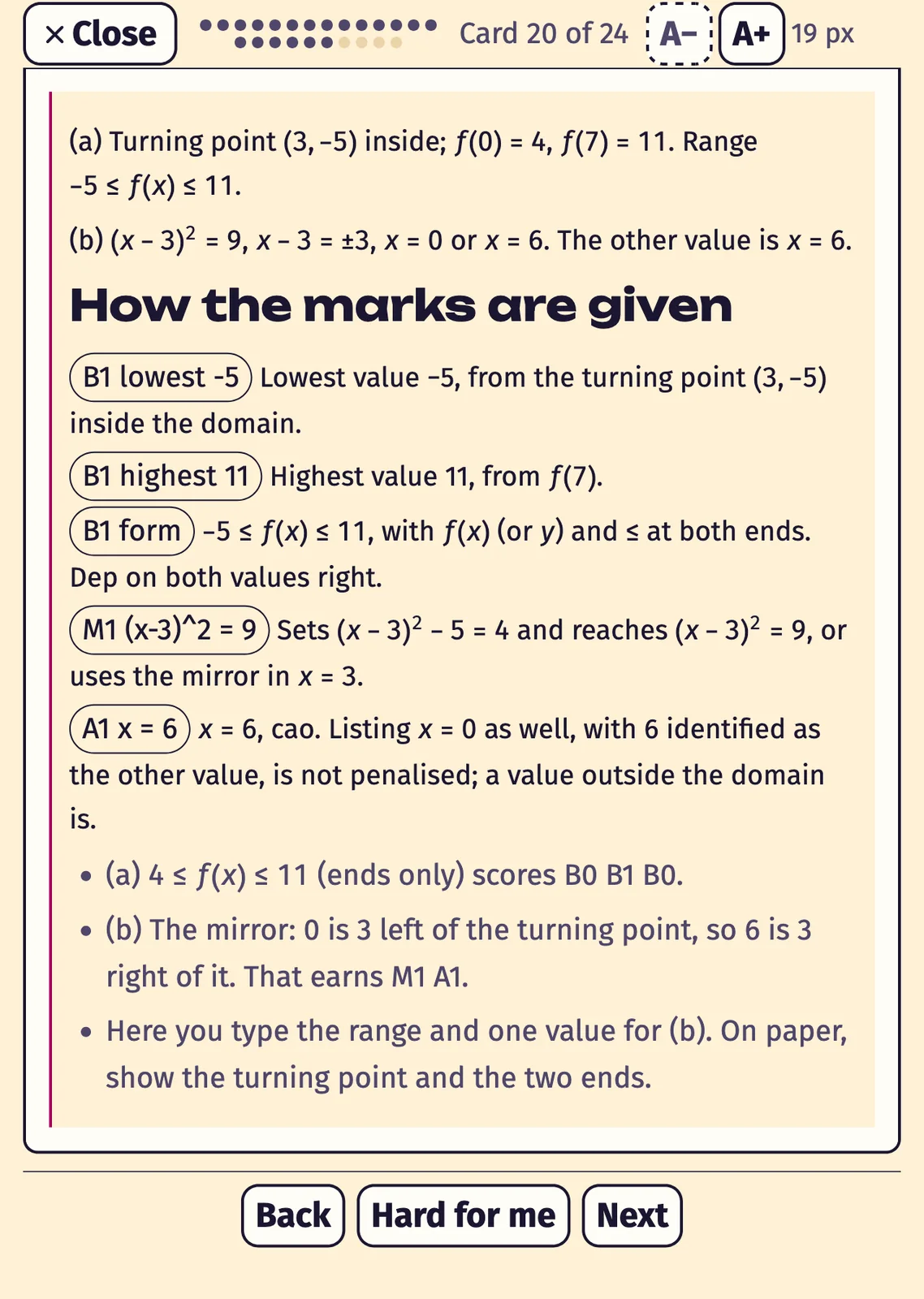
Card lessons end with exam-style questions. After the answer comes the worked solution, with a mark tag on each line (B1, M1, A1), so your teenager sees what earns a mark. The questions and mark notes are our own.
- Open the picture at full size
The full lesson says why it matters
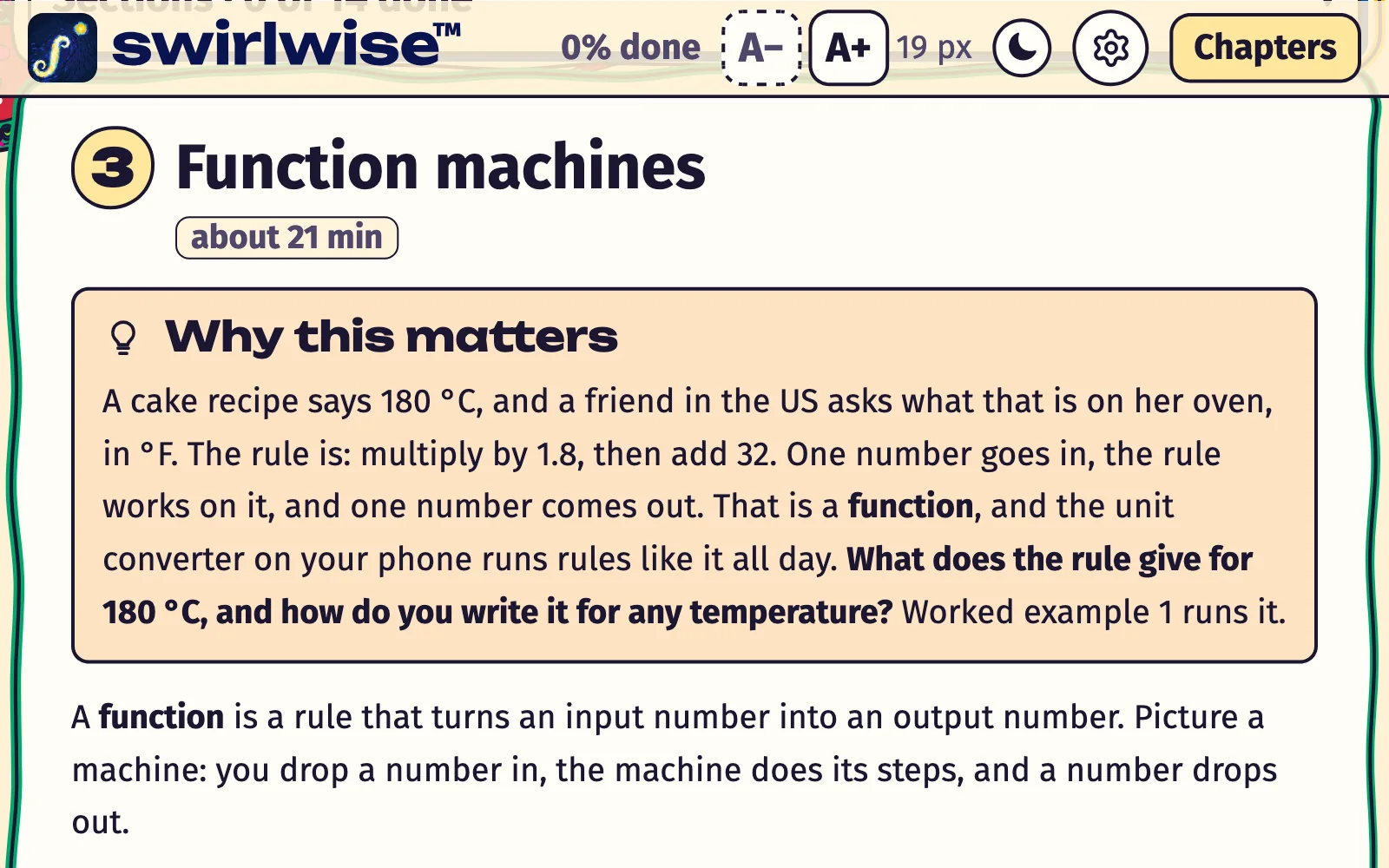
The Workshop is the full lesson of a chapter. Each section opens with "Why this matters", then explains, shows examples and sets practice. Chapter 1 has 14 sections, about 5.5 hours of work, cut into 6 study sessions.
- Open the picture at full size
One map for the whole course
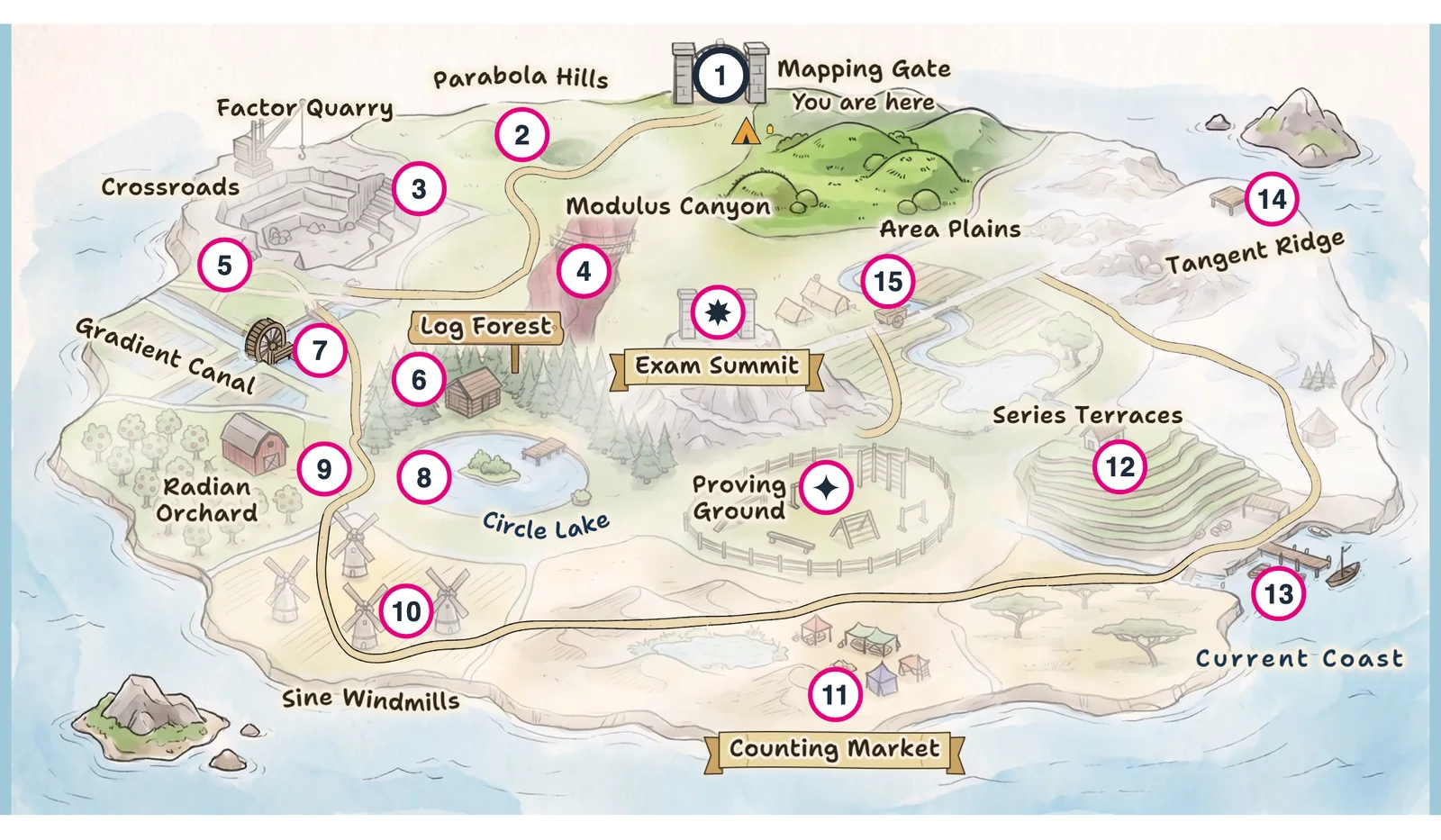
Each chapter is a land on one island, from Mapping Gate to Exam Summit. The map shows where your teenager is and what comes next.
- Open the picture at full size
A plan that ends at the exam
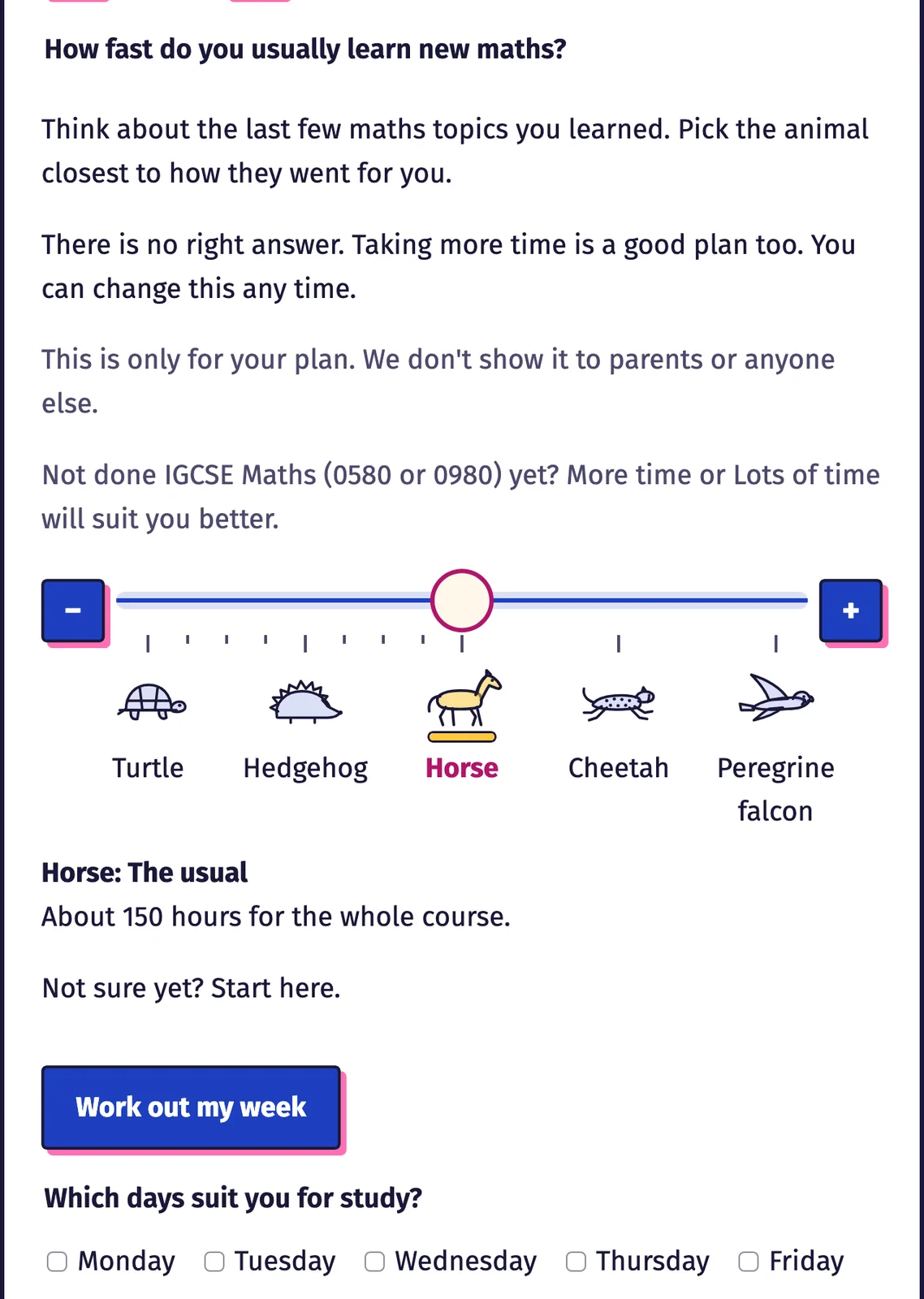
Your teenager picks the exam series, the days of the week and a pace. The planner works out the weeks and a done-by date for each chapter. The course works without it, too.
Like what you see?
Join the waiting list. It is free, and we write to you when the course opens.
How the course teaches
Six habits shape the course.
Why before how
An idea starts in a situation where it does real work: an oven, a thermometer, a locked gate. The rule comes after the question.
Shown, then shared, then alone
First a full worked example. Then examples with a step left open. Then questions with no help on the page, and hints one tap away.
Checked at every step
Answers are checked at once, so a slip is caught where it happens and not three pages later.
Words and pictures together
Where the maths has a shape, the graph stands beside the algebra and moves with it.
Good places to stop
Lessons are cut into short study sessions, and each one ends at a place to pause. There are no streaks and no leaderboards.
Paper stays
The exam is written by hand. Exam-style cards say what to show on paper, and the story's hero works things out on paper too.
Who makes the course
Alexander TangMaster of Education
Course developer
Every lesson, drawing, story and question is our own work.
The idea behind it
Learning should keep its wonder. Mathematics is full of patterns that connect, and a course should let a learner find them, one clear step at a time.
The 15 chapters
The course follows the Cambridge IGCSE Additional Mathematics syllabus (0606), which is shared with Cambridge O Level Additional Mathematics (4037). It starts from what IGCSE Maths teaches.
Chapters 1 to 4 are in testing now. The other chapters are being built and tested in order.
Functions
Mapping GateIn testing now
Number machines: which inputs they take and which outputs can come out. Run a machine backwards, chain two together, fold a graph up with |f(x)|.
Quadratic functions
Parabola HillsIn testing now
Complete the square to find where a parabola turns and how high or low it goes. Use b² − 4ac to tell if a line cuts the curve, touches it or misses it.
Factors of polynomials
Factor QuarryIn testing now
Put one number into a polynomial and the remainder tells you if it is a factor. Split a cubic into a linear factor times a quadratic, then solve it.
Equations, inequalities and graphs
Modulus CanyonIn testing now
Solve modulus equations and inequalities, by algebra or from a careful sketch. Spot the quadratic hiding in a harder equation; sketch cubics and their folds.
Simultaneous equations
CrossroadsBeing built
Find where a straight line meets a curve by putting one equation into the other. Count the meeting points first, then pair every x with its own y.
Logarithmic and exponential functions
Log ForestBeing built
Meet eˣ and ln x, two curves that undo each other, and their asymptotes. Use the log laws to bring x down from a power and solve the equation.
Straight-line graphs
Gradient CanalBeing built
Midpoints, lengths, parallel and perpendicular lines, perpendicular bisectors. Choose axes that turn a curved law into a straight line, then read its constants.
Coordinate geometry of the circle
Circle LakeBeing built
Find a circle's centre and radius from any form of its equation. Where a line meets a circle: a chord, a tangent, or no contact at all.
Circular measure
Radian OrchardBeing built
Measure angles in radians, the way a circle measures itself. Find arc lengths and sector areas, then build harder shapes from them.
Trigonometry
Sine WindmillsBeing built
Six trig functions and their wave graphs, with amplitude and period. Solve trig equations in a given range, and prove identities line by line.
Permutations and combinations
Counting MarketBeing built
Count arrangements where order matters and selections where it does not. Use n!, ⁿPᵣ and ⁿCᵣ, with rules like "these two must stand together".
Series
Series TerracesBeing built
Expand (a + b)ⁿ and find one chosen term, such as the term without x. Arithmetic and geometric progressions, their sums, and endless sums with a total.
Vectors in two dimensions
Current CoastBeing built
Write vectors in every form, find lengths and unit vectors, solve geometry. Add velocities, track a moving point with r = r₀ + tv, see if two paths meet.
Differentiation
Tangent RidgeBeing built
Differentiate powers, trig, eˣ and ln x with the chain, product and quotient rules. Find tangents, normals, rates of change and the highest or lowest point.
Integration and kinematics
Area PlainsBeing built
Integrate by running differentiation backwards, with + c where it belongs. Find areas under and between curves; follow a particle with s, v and a.
Two more lands close the map: Proving Ground, with mixed questions from all 15 chapters, and Exam Summit, the two written papers.
Questions parents ask
- Who is the course for?
- For teenagers aged about 14 and up who learn Additional Maths on their own, at home or next to school. Additional Maths itself starts at square one here. It builds on IGCSE Maths, and the first section of chapter 1 refreshes what is needed.
- Which exams is it for?
- Cambridge IGCSE Additional Mathematics (0606) and Cambridge O Level Additional Mathematics (4037). Swirlwise is not affiliated with or endorsed by Cambridge University Press & Assessment.
- Is the exam part of the course?
- No. Your teenager sits the exam at an exam centre, as a private candidate. Our free guide for families on the waiting list explains how that works in the UK.
- What does my teenager need?
- A laptop or a tablet with a current browser, paper and a pencil. Progress is saved to the account, so it is the same on every device.
- Do I have to teach?
- No. The course does the teaching. An adult at home keeps an eye on the plan and the pace.
- When does it open, and what does it cost?
- The opening month is at the top of this page. The price is not set yet. Families on the waiting list hear both before anyone else.
Join the waiting list
- Learn it alone without getting lost. Each topic goes from the first idea to exam-style questions, one checked step at a time.
- Made for one learner at a time. Your teenager works at their own pace, with no class to keep up with and no leaderboards to chase.
- Free things first. Join now for our free guide to sitting 0606 in the UK (out 5 November), two free lessons in December, and first pick of 50 founding-family places.
Are you the learner? Free lessons are planned for December, with no account needed. Bookmark this page and come back then.